What Every CEO Gets Wrong About Writing a Book (And What the Smart Ones Do Differently) Let’s get something out of the way. Smart people write mediocre books all the time.And often, the most brilliant minds never publish at all. It’s not a lack of intelligence. It’s not a shortage of ideas.It’s the blind spots. […]
What CEOs Get Wrong About Books
What Every CEO Gets Wrong About Writing a Book (And What the Smart Ones Do Differently)
Let’s get something out of the way.
Smart people write mediocre books all the time.
And often, the most brilliant minds never publish at all.
It’s not a lack of intelligence. It’s not a shortage of ideas.
It’s the blind spots.
In working with CEOs, founders, and high-performing professionals, I’ve seen the same patterns over and over. These are the myths that stall the process—or worse, lead to books that check a box but never make an impact.
Let’s break them down.

Mistake 1: Believing It Has to Be “Perfect” Before You Start
This is where the most successful people get stuck. You’re used to delivering excellence. Precision. Strategy. And the idea of creating something permanent—especially something public—brings out a hidden fear:
What if it’s not good enough?
So you wait. You tweak the outline. You rethink the angle. You set it aside for next quarter.
And years go by.
The smartest CEOs understand that clarity doesn’t come first. It comes through the process. The act of writing—or speaking, or brainstorming with the right team—creates the clarity you’ve been waiting for.
Start messy. Get support. Refine along the way.
Mistake 2: Trying to Write the Book Like a Legal Brief or Investor Deck
This one is especially common for CEOs with a background in law or finance. You’re used to writing to convince, to argue, to prove.
But the most powerful books don’t read like a pitch.
They read like truth.
They bring the reader into your worldview. They show what others can’t see. They offer clarity, not just conclusions.
The CEOs who get it right know their book isn’t about selling. It’s about positioning. Not by shouting credentials, but by shaping a compelling narrative that demonstrates their insight without having to explain it.

Mistake 3: Delegating the Wrong Things
You should not be writing 10 hours a week. But you also shouldn’t hand over your story to someone who doesn’t understand your voice, your industry, or your strategic goals.
The book only works if it sounds like you—and not just in tone, but in depth. That requires a collaborative process. One where you bring the raw insight, and a team helps you shape it into something extraordinary.
The smartest CEOs don’t outsource their expertise.
They streamline how it gets expressed.
Mistake 4: Thinking It’s “Just a Book”
This is a big one.
Because on the surface, a book is just another asset.
But underneath, it’s often the missing piece.
The missing clarity about your methodology.
The missing leverage that turns one conversation into a hundred.
The missing positioning that shifts you from being known for what you do to being remembered for how you think.
As Harvard Business Review notes, thought leadership isn’t built by volume. It’s built by resonance.
A book that resonates doesn’t just share information. It transforms perception.
The CEOs Who Get It Right? They See the Book for What It Is
Not a vanity project.
Not a step-by-step manual.
Not something to crank out in 30 days and forget about.
They see it as a long-term asset. A positioning tool. A legacy piece that speaks for them in rooms they haven’t even entered yet.
And they build the right team to bring it to life—without sacrificing their time, voice, or standards.
If you’ve been circling the idea of a book but haven’t made it happen yet, you’re not alone. And you’re not behind.
You’re just one shift away from doing it the smart way.
No overwhelm. No burnout. No generic content.
Just your expertise, brought to life with intention.
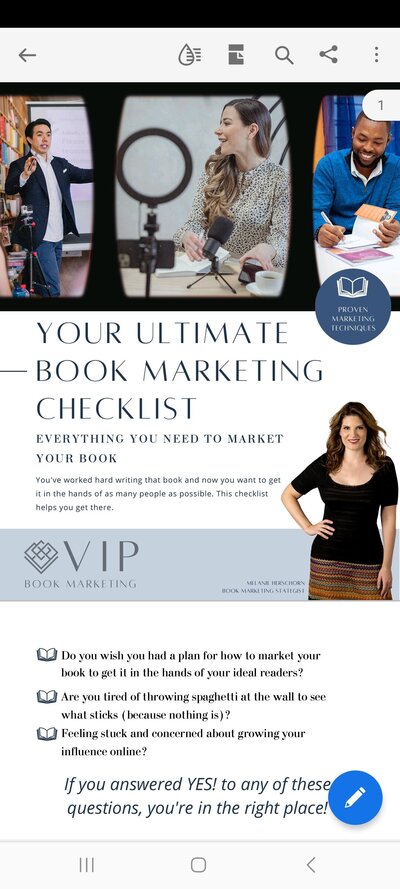
Make a list and check it twice! Learn exactly what you need to have to effectively market your book!
THE ULTIMATE BOOK MARKETING CHECKLIST
Hey AUTHORS!
send IT TO ME!